

AI receptionistsOnline
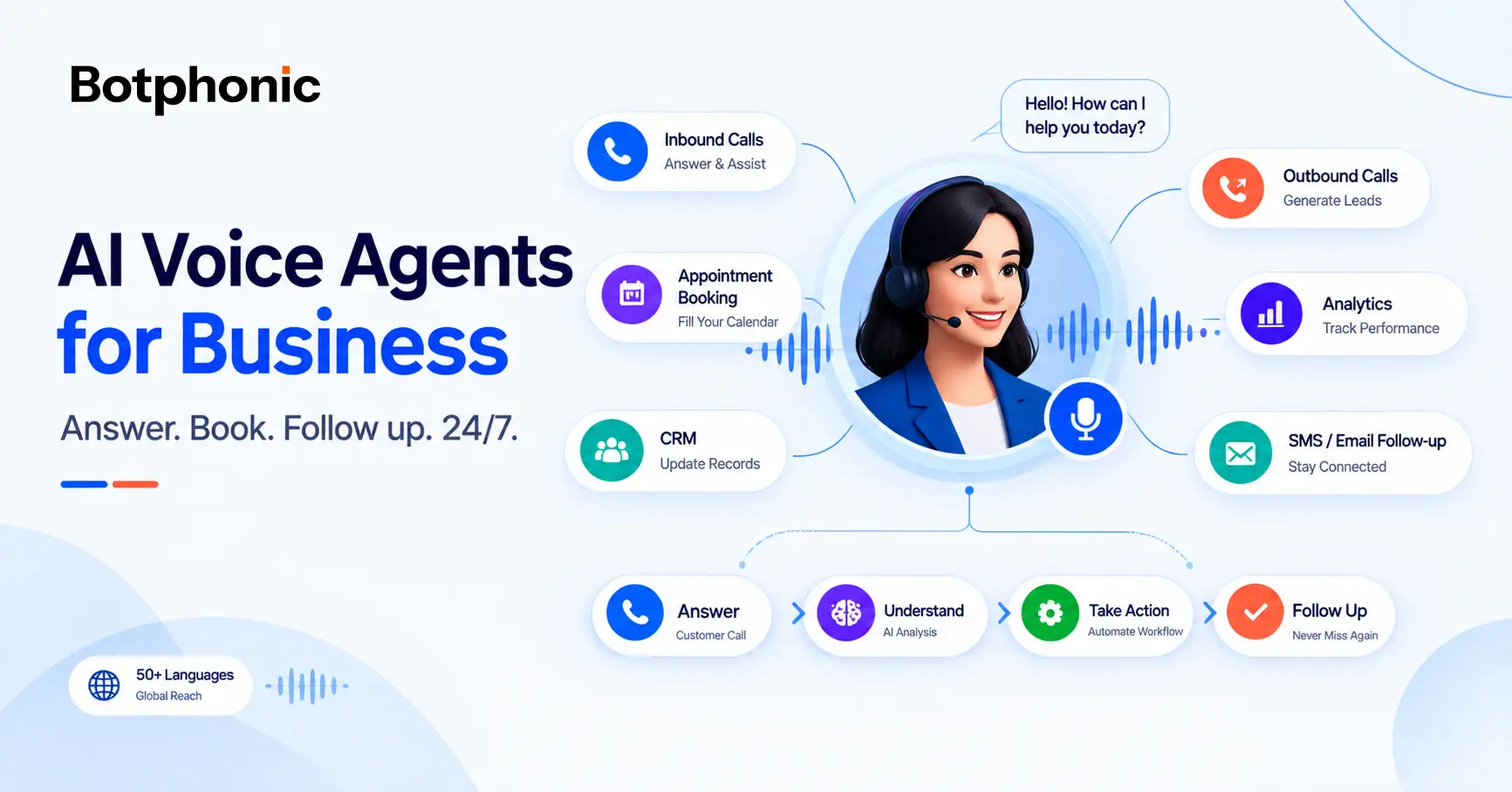
Botphonic
AI voice agents and AI answering service that answer, book and follow up on business calls.
- Languages
- 50 languages
VoiceAgents lists 197 voice AI vendors. Compare pricing models, starting prices, languages, telephony and compliance, with a link to the vendor's own source.



AI receptionistsOnline
AI voice agents and AI answering service that answer, book and follow up on business calls.
Voice AI APIsOnline
Speech-to-text API that transcribes and enriches conversations for voice products.

Voice AI APIsOnline
Text-to-speech voice models built for real-time conversations, with 600+ voices, 50+ languages and sub-100ms latency.
Voice agent platformsOnline
Build, deploy, and monitor AI voice agents that sound human. Self-hosted models, sub-second latency, and enterprise compliance.
Voice agent platformsOnline
Bolna AI builds voice AI agents in 20+ languages. Automate support, sales and recruitment calls in Hindi, Hinglish, Tamil, Telugu and more.

Voice AI APIsOnline
Cartesia builds real-time voice AI: production voice agents, lifelike text-to-speech, and accurate speech-to-text in 44 languages.
Buyer guides
Run a small, measured pilot before you commit. Pick one call type, set success measures, sign the compliance documents, test on recorded scripts, go live on a share of calls with a human fallback, then review the recordings and decide.
Read guide: Getting Started: A Pilot Plan for Your First AI Phone AgentBuyer guides
An AI receptionist answers a business's inbound calls. Contact-centre voice AI automates a support queue at scale. Outbound calling software makes calls and must follow consent rules. A voice API gives engineers the parts to build their own agent.
Read guide: AI Receptionist vs Contact-Centre Voice AI vs Outbound Calling vs Voice APIRun a small, measured pilot before you commit. Pick one call type, set success measures, sign the compliance documents, test on recorded scripts, go live on a share of calls with a human fallback, then review the recordings and decide.
An AI receptionist answers a business's inbound calls. Contact-centre voice AI automates a support queue at scale. Outbound calling software makes calls and must follow consent rules. A voice API gives engineers the parts to build their own agent.
Most AI voice agents bill per minute of talk time. The total is a stack: a platform fee, the language model, speech-to-text, text-to-speech and telephony. Some vendors bundle the stack into one rate; others sell annual contracts.
Before an AI voice agent takes real calls, check five areas: HIPAA and a BAA for health data, a SOC 2 report, a GDPR processing agreement, PCI DSS for card payments, and call recording and robocall consent rules, including the FCC's 2024 ruling on AI voices.
You can build a voice agent on an open-source framework such as Pipecat or LiveKit Agents, assemble it from voice AI APIs, or buy a managed platform. Building gives control and needs engineers. Buying is faster and gives less control.
Start with the calls you want to automate. Then check six things in order: call type, integrations, compliance, concurrency, pricing model and control. Test a short list of vendors on your own calls before you sign.
Ask about the full cost at your volume, concurrency limits, which model and voice providers the vendor uses, data retention, compliance documents, human handoff and how you leave. Get every answer in writing.
Plain definitions of the voice AI terms that vendors use: latency, barge-in, turn detection, STT and ASR, TTS, speech-to-speech, SIP trunking, warm transfer, concurrency, BAA and more.
Evan Bench, CC BY 2.0, commons.wikimedia.org · Galak76, CC BY-SA 3.0, commons.wikimedia.org · Carl Lender, CC BY 2.0, commons.wikimedia.org · Shixart1985, CC BY 2.0, commons.wikimedia.org.
Published by VoiceAgents. How we check each voice AI vendor.
A short email now and again: a vendor worth knowing, a price change and one source note. No noise.


